aaa
aaa
Behind Oxford’s oldest non-religious tower lies a gripping tale of Viking raids, bloody Saxon vengeance, and a town’s fight for survival.
St. George’s Tower is the oldest part of Oxford Castle & Prison, a remarkable surviving example of Anglo-Saxon architecture. Its construction, however, followed one of the nastiest events in Oxford’s history, the St. Brice’s Day Massacre of 1002 and the subsequent Viking raid on the town.
Viking raiders were hardly new to England by the 11th century, but the years leading up to the massacre had seen numerous raids across the country, facing little opposition from Saxon forces. The King, Æthelred the Unready, had been infamously unable to deal with the crisis and likely needed some sort of success to shore up his own support.
After hearing alleged reports that the Danes intended to murder him and take England for themselves, Æthelred ordered the Danes in England to be massacred on St. Brice’s Day, the 13th of November. It’s not clear whether he chose this date deliberately for a particular reason.

It’s unlikely that he targeted all Danes in the country, rather he sought to eliminate the young men – those who might join the Danes and fight against him.
This was nonetheless acted out with tremendous enthusiasm by the Saxons, particularly in Oxford. The massacre is recorded both in the Anglo-Saxon Chronicle and in a diploma written by Æthelred to the Church of St. Frideswide. The latter concerns Oxford and it recounts how the Danes of Oxford fled into the church hoping to seek sanctuary in its walls, only for the Saxons to burn it to the ground, with everyone inside being killed as a result.
The manner of this “just extermination” of the Danes, as Æthelred called it, seemed to have been a last resort to avoid destroying the church and its ornaments, which required Æthelred’s patronage to be rebuilt. These accounts present a shocking massacre, one which was not entirely believed until recently.
In 2008, excavations in St John’s College revealed 35 skeletons of young men, likely dumped there in the late 10th or early 11th century – many with numerous wounds and burn marks, not dissimilar from the account of the massacre. Whilst their connection to it is still disputed, it certainly shows that Oxford’s relationship with the Danes was a tense one at best.
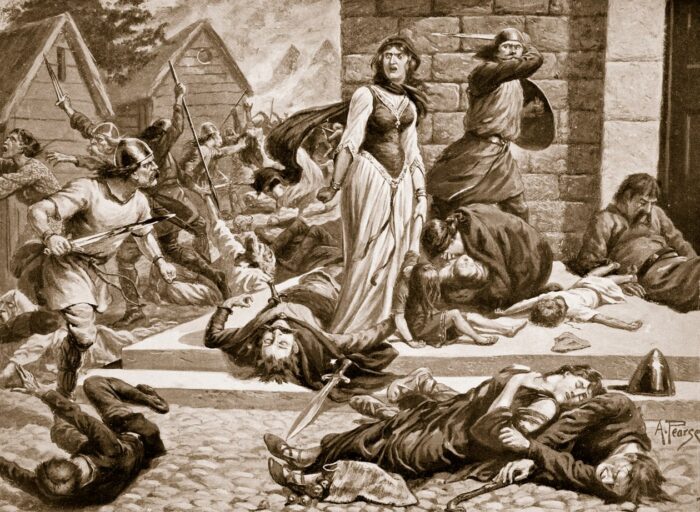
The infamy of this event would last long after it had occurred. Anglo-Norman chroniclers of the 12th century would claim numerous details which are unlikely to have happened. Allegations of women and children being massacred or chased down by dogs, with “Gunnhild”, claimed sister of King Sweyn Forkbeard of Denmark, among them. This is a commonly attributed reason for why Sweyn launched an invasion of England in the years after the massacre, though it is most likely a myth. Despite that, the Vikings would return to Oxford in force.
In 1009, an army under Thorkell the Tall would burn Oxford to the ground before the rebuilt town would surrender to Sweyn four years later, handing over hostages in the process.
Despite this hostility, Oxford later became the site of reconciliation between the Danes and Saxons. In 1018, King Cnut the Great held council in the town, where it was agreed that both Danes and Saxons would follow the same laws, effectively ending any legal distinction between the two.
In the aftermath, the town’s defences were heavily strengthened with stone walls and towers built to prevent the raid of 1009 from happening again – this included St. George’s Tower. It was built to guard the Westgate of the town. Nowadays, the Saxon Tower is an exciting part of our guided tours, allowing you to not only take in the view of the city, but also see and hear about its storied past!
If you love a historic walk, you can follow the route of the city walls and discover where the gates once stood, or still stand today, using a free walking guide from Oxford Archaeology.


Oxford Castle & Prison
44-46 Oxford Castle, Oxford OX1 1AY
Heritage Projects (Oxford Castle) Ltd
Registered in England No: 5763243
Registered Office: St. Edmund's House, Margaret Street, YORK, YO10 4UX





| Cookie | Duration | Description |
|---|---|---|
| cookielawinfo-checkbox-advertisement | 1 year | Set by the GDPR Cookie Consent plugin, this cookie is used to record the user consent for the cookies in the "Advertisement" category . |
| cookielawinfo-checkbox-analytics | 11 months | This cookie is set by GDPR Cookie Consent plugin. The cookie is used to store the user consent for the cookies in the category "Analytics". |
| cookielawinfo-checkbox-functional | 11 months | The cookie is set by GDPR cookie consent to record the user consent for the cookies in the category "Functional". |
| cookielawinfo-checkbox-necessary | 11 months | This cookie is set by GDPR Cookie Consent plugin. The cookies is used to store the user consent for the cookies in the category "Necessary". |
| cookielawinfo-checkbox-others | 11 months | This cookie is set by GDPR Cookie Consent plugin. The cookie is used to store the user consent for the cookies in the category "Other. |
| cookielawinfo-checkbox-performance | 11 months | This cookie is set by GDPR Cookie Consent plugin. The cookie is used to store the user consent for the cookies in the category "Performance". |
| PHPSESSID | session | This cookie is native to PHP applications. The cookie is used to store and identify a users' unique session ID for the purpose of managing user session on the website. The cookie is a session cookies and is deleted when all the browser windows are closed. |
| viewed_cookie_policy | 11 months | The cookie is set by the GDPR Cookie Consent plugin and is used to store whether or not user has consented to the use of cookies. It does not store any personal data. |
| Cookie | Duration | Description |
|---|---|---|
| _ga | 2 years | The _ga cookie, installed by Google Analytics, calculates visitor, session and campaign data and also keeps track of site usage for the site's analytics report. The cookie stores information anonymously and assigns a randomly generated number to recognize unique visitors. |
| _gat_UA-9822230-4 | 1 minute | A variation of the _gat cookie set by Google Analytics and Google Tag Manager to allow website owners to track visitor behaviour and measure site performance. The pattern element in the name contains the unique identity number of the account or website it relates to. |
| _gcl_au | 3 months | Provided by Google Tag Manager to experiment advertisement efficiency of websites using their services. |
| _gid | 1 day | Installed by Google Analytics, _gid cookie stores information on how visitors use a website, while also creating an analytics report of the website's performance. Some of the data that are collected include the number of visitors, their source, and the pages they visit anonymously. |
| CONSENT | 2 years | YouTube sets this cookie via embedded youtube-videos and registers anonymous statistical data. |
| Cookie | Duration | Description |
|---|---|---|
| _fbp | 3 months | This cookie is set by Facebook to display advertisements when either on Facebook or on a digital platform powered by Facebook advertising, after visiting the website. |
| fr | 3 months | Facebook sets this cookie to show relevant advertisements to users by tracking user behaviour across the web, on sites that have Facebook pixel or Facebook social plugin. |
| test_cookie | 15 minutes | The test_cookie is set by doubleclick.net and is used to determine if the user's browser supports cookies. |
| VISITOR_INFO1_LIVE | 5 months 27 days | A cookie set by YouTube to measure bandwidth that determines whether the user gets the new or old player interface. |
| YSC | session | YSC cookie is set by Youtube and is used to track the views of embedded videos on Youtube pages. |
| yt-remote-connected-devices | never | YouTube sets this cookie to store the video preferences of the user using embedded YouTube video. |
| yt-remote-device-id | never | YouTube sets this cookie to store the video preferences of the user using embedded YouTube video. |